
The new rules allow for a staggered implementation road map, giving companies, data fiduciaries, data principals, and other stakeholders up to 18 months to comply with the administrative guidelines under the DPDP Act.

The Bombay High Court has ruled that the fundamental right to privacy includes the right to be forgotten. This decision came after a man sought to have his name and details removed from court records following the quashing of an FIR against him, arguing that public access to such information prejudiced his career and caused personal stigma. The court emphasised balancing public access to information with an individual's right to privacy.

Legal database platform India Kanoon has approached the Delhi High Court, challenging a single-judge order that recognised an individual's 'right to be forgotten' and directed the platform to de-index and disable 'name-based search functionality' for certain judicial orders.

Population Foundation of India welcomes the digitisation of the Census but emphasises the need for inclusivity, data security, and addressing the under-reporting of women's contributions.

WhatsApp is finally letting you hide your phone number behind a custom username. While it's a massive win for privacy, cybersecurity experts warn it could unleash a wave of identity scams. Here is what you need to know.

India has launched an open Health AI benchmarking platform to evaluate artificial intelligence models on diverse Indian datasets before deployment at a population scale. The initiative aims to strengthen AI-driven claims management under the Ayushman Bharat Pradhan Mantri Jan Arogya Yojana (AB PM-JAY).

The Indian government has issued a notice to Meta regarding WhatsApp's upcoming username feature, warning the platform not to roll it out until concerns about potential fraud, impersonation, and public safety are addressed to the government's satisfaction.

The Supreme Court of India has agreed to examine petitions challenging the constitutional validity of the Digital Personal Data Protection (DPDP) Act, 2023, focusing on concerns about its impact on the Right to Information Act.

Prime Minister Narendra Modi is promoting India as a global hub for digital infrastructure and artificial intelligence, highlighting the government's incentives for data center investments and inviting the world's data to reside in India.

The Delhi High Court has recognised an individual's 'right to be forgotten', ruling that search engines cannot perpetually display judicial records in name-based searches for private cases or those ending in acquittal.

Dr Lovi Raj Gupta, pro vice-chancellor, Lovely Professional University, explains how aspiring professionals can equip themselves for a competitive AI-driven job market.

The court is hearing appeals against a CCI order imposing a penalty on Meta and WhatsApp.

The Unique Identification Authority of India (UIDAI) has announced that nearly 100 entities have been onboarded as offline verification seeking entities (OVSEs), marking a significant step in enabling secure, consent-based, and paperless verification through the Aadhaar offline mechanism.

The Supreme Court has ruled that threatening to publish a video of a woman disrobing or bathing on social media constitutes criminal intimidation under the Indian Penal Code.

An EY India report suggests that banks must compete on customer experience and evolve physical branches into phygital advisory hubs. The report highlights the importance of anticipating customer needs and blending digital tools with human interaction.

'Digital arrests are the cutting edge of the problem and the most challenging part of the ecosystem right now.'

Families of 15 of the 260 victims of last year's Air India plane crash in Ahmedabad have declined to collect the personal belongings of their loved ones, while ex-gratia payments of Rs 1 crore have been disbursed to 91 per cent of the families of the deceased.

'What we are seeing today is India stepping into its digital confidence, not as a follower but a leader.'

ServiceNow Vice Chairman Nick Tzitzon highlights India's potential to develop an AI-native government model, emphasising enhanced public services, data privacy, and economic growth.
Karnataka Chief Minister Siddaramaiah has called for the establishment of a Supreme Court bench in South India to improve accessibility to justice. Speaking at a conference on Artificial Intelligence in the judiciary, he also highlighted the need to address algorithmic bias and ensure judicial independence in the age of AI.

Nasscom President Rajesh Nambiar highlights India's growing importance as a technology partner due to geopolitical uncertainties and the need for resilient supply chains.

Loneliness can engulf people at different stages in their lives. Weighing in on their lonely state of mind are three people -- a soul-searching Gen Z stage actress, Malikka Advani; a beleaguered big-tech employee in his 40s, Vinod Patel; and a confidence-exuding business writer, Maya Lalchandani -- who reveal the different methods they employ to tackle this emotion.

A cybersecurity expert warns that cyberattacks are increasingly targeting critical infrastructure, posing direct risks to human lives beyond mere data theft. The convergence of IT and OT expands the attack surface, making sectors like aviation, transport, and public utilities highly vulnerable.

"It's easier, easier than ever now to impersonate someone, to create deep fakes, to manipulate images, to misuse personal data. And most women, unfortunately, we don't know how to fight back," says Soha Ali Khan.

Indian car buyers care more about affordability than technology, keeping ICE vehicles dominant while hybrids emerge as the preferred transition option and EVs struggle in the mass market.

LIK: Love Insurance Kompany is an ambitious film for its setting, but underscores in both the romance and the humour departments. The world-building is vibrant, the ideas are relevant, but the storytelling lacks the depth and conviction needed to bring them together meaningfully
Karnataka Chief Minister Siddaramaiah emphasized the importance of ethical AI usage, intellectual property protection, and fair compensation in the AVGC-XR sector, advocating for AI to enhance human creativity rather than replace artists.

Vertex Group has launched its 'Responsible AI Lab' with a Rs 100 crore investment in research and development, focusing on ethical, transparent, and accountable AI solutions for businesses.
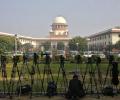
The Supreme Court of India is examining the conflict between an individual's 'right to be forgotten' and the freedom of the press, focusing on the removal of online news and judicial records related to acquitted individuals.

The artificial intelligence (AI) ecosystem is opaque and needs to be made transparent and accountable, said Competition Commission of India's (CCI) Chairperson Ravneet Kaur at the Business Standard Manthan Summit on Wednesday.

Rahul Gandhi claims the Indo-US trade deal will compromise the data security of 1.5 billion Indians, alleging Prime Minister Modi is surrendering India's data resources to the US. He warns of potential job losses in the IT sector due to AI and the importance of controlling India's data pool.

'There is a challenge in repositioning yourself, maybe reinventing yourself.'

Across all sectors, the future of work depends on adaptability.

India launches AI-driven SPEEED platform to track athlete performance, predict injuries, tackle age fraud and revolutionise sports science nationwide.

'We are in touch with industry to further compress the timelines.'

'By extending the definition of 'personal' to include institutions and not just individuals, the State has equipped itself with a tool to block access to most kinds of information.'

'The impact will be minimal and it will only increase compliance cost on consent, data flows, localisation timelines, internal audits, data mapping, and new tooling.'

India's information technology (IT) spend is projected to touch $176.3 billion in 2026, rising 10.6 per cent from 2025, and outpacing the 9.8 per cent growth expected globally, according to the latest forecast by Gartner Inc., a business and technology insights company.

Lack of clarity on data-sharing persists, public health experts sceptic about the pilot that was run in six Union territories as benchmark for national roll-out

The "construct of the DPDP Act" cannot be changed at this stage, though there may be some minor tweaks in the language of the Rules and formats in certain legitimate cases.
